All you need to know about Ileostomy Care

What do you mean by Ileostomy care?

Ileostomy care is very important for the cleanliness of the ileostomy and the nearby skin. It aids in avoiding skin issues. Your ileostomy expert will guide you about how to take care of your ileostomy.

What are the most used products for the care of an ileostomy?

Pouches are used for the collection of bowel contents that pass out from the stoma. There is a spout at the bottom of the pouch from where the liquid drains out. They are available in different sizes and styles. Most of the pouches are light in weight and odor resistant. Some of the pouches have a filter for the release of odor. You should use a pouch that has an opening almost 1/8 inches larger than the stoma on each side. Your Ostomy nurse can help you to decide the best pouch for you.

Skin protection may be useful for the cleanliness of skin and avoiding any kind of skin discomforts. It involves films, strips, or rings.

How to empty the ileostomy bag?

You need to drain your pocket each four to six hours every day. It is prescribed to purge the pocket when it is 1/third filled. Make an effort not to fill the pocket. On the off chance that your pouch is full it will cause tension on the seal and it can prompt spillage. There is additionally the likelihood that the pouch may get isolate and the gut content sprinkle out. 

  • To begin with, hold the pouch from one end. Remove the clips. 
  • Roll the closures of the pouch. This will keep the edges clean. 
  • Spread tissue on the latrine seat to abstain from scattering. Then, at that point void the pack in the latrine. 
  • Unfurl the finishes of the pack. Use a tissue or a clammy towel for cleaning the closures. 
  • Spot the clasps again and close the mouth of the pouch

How to change the pouch?

Empty the bowel contents in the toilet.

  • .Take off the pocket kindly. You should squeeze your skin descending and pull the skin hindrance with the other hand. Always utilize warm water for cleaning the peristomal skin. You can even utilize cleanser. Try not to utilize cleansers with oil. Allow your skin to dry or pat dries it. Locate your new pouch over the stoma and press it delicately so it follows with the cleaned and dried skin. It is encouraged to pat the pouch for 30 seconds. The warmth from your hands will upgrade the c flange boundary to fit appropriately. 

You can dispose of or clean your old pouch. You should keep the pocket in another plastic sack prior to disposing of it. On the off chance that you are utilizing a reusable pouch or bag you can figure out how to clean it and use it once more.

What diet changes are needed?

You should consume the foods that the digestive system cant digest easily for 6 to 8 weeks following the surgery. For instance meat, nuts, seeds, and raw veggies and fruits. You can continue the normal diet after 6 to 8 weeks.

You should avoid eating foods that cause cramps and diarrhea. When you resume these kinds of foods then start with the small amounts.

Lessen the odor and gas. Avoid using any straw for drinking. Eat-in portions and eat slowly. Some foods that cause odor and gas are:

You ought to devour the food sources that the stomach related framework cannot process effectively for 6 to about two months following the medical procedure. For example meat, nuts, seeds, and crude veggies and organic products. You can proceed with the ordinary eating routine following 6 to about two months. 

You ought to try not to eat food sources that cause spasms and the runs. At the point when you continue these sorts of food sources then, at that point start with the modest quantities. 

Reduce the smell and gas. Abstain from utilizing any straw for drinking. Eat-in parcels and eat gradually. A few food varieties that cause odor and gas are:

  • Cabbage
  • Capsicum
  • Beans
  • Eggs
  • Fish

Some foods that help to reduce odor and gas are:

  • Parsley
  • Yogurt
  • Buttermilk
  • Drink more liquid. You need to drink extra glasses of water to avoid dehydration. You can consult with your doctor about the exact amount of water you need to drink throughout the day.

How can I adapt to the ileostomy?

You can return to your work when allowed by your doctor. You should avoid lifting heavy weights and should use support to avoid a hernia. You can use an Ostomy belt to keep the pouch in place.

Keep yourself active and do exercise with the proper guidance. You can take help from your healthcare expert about the best possible plan for exercise. You should wear a pouch while swimming. You can use waterproof tape to cover the ends to avoid any leakage. You should empty your pouch before having sex or doing exercise.

You should always keep extra appliances and clothes with you. 

When should I call my doctor?

  • If you have a temperature
  • If you observe any stomal change in size and color
  • You notice tablets ( medicine) in your waste material
  • You have a red stoma or rash.
  • You have diarrhea or very loose bowel movements above 6 hours.
  • You notice any unusual odor that continues for more than a week.
  • Your waste is in black or there is any blood.
  • You are having vomiting and nausea
  • You have any confusion.

When should I call the emergency care center?

  • There is continuous bleeding from the stoma.
  • You are so feeble that you can’t even stand on your feet
  • You are having severe abdominal pain
  • Bowel contents are not passing out through the stoma.

The Bottom Line

 You must know your condition and how to treat it. You can consult with your doctor and surgeon for more queries.

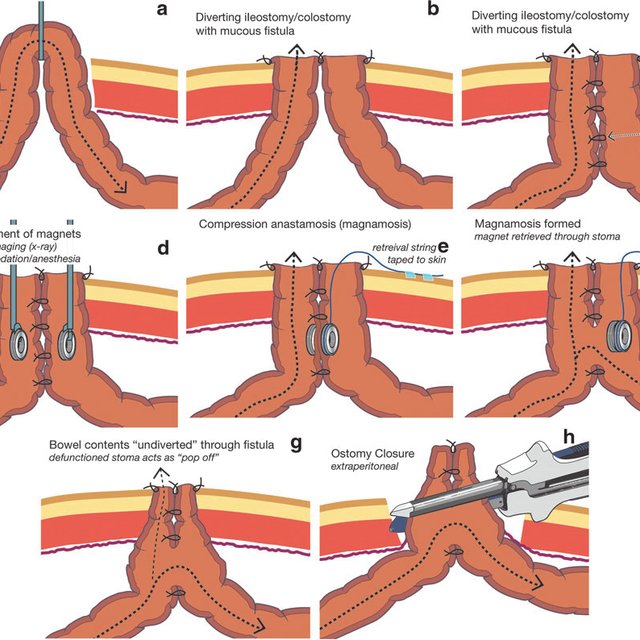
What is meant by ileostomy-reversal?

An ileostomy closure or reversal is a surgery that is performed to close the temporary ileostomy. Your surgeon will reconnect the ileum with the colon. Your stoma will be also closed at the end.

What happens before the surgery?

  • You might require an enema before the surgery. The enema involves a contrast liquid that can be shown in the x-ray. Your surgeon will ensure that there is no leakage of the contrast liquid in the colon. He will also observe your anal sphincter to ensure that they are working properly. Your healthcare expert can guide you in a better way about the other tests that are needed.
  • One day before the surgery you will be asked to stop eating solids and only drink simple water.
  • You will not be allowed to eat or drink anything 8 hours before the surgery.
  • Your healthcare provider will guide you about the medicines on the morning of the surgery.

What happens during the surgery?

  • First of all, you will be given anesthesia so that you will remain asleep and you feel no pain during the surgery.
  • Your healthcare expert will cut the stoma. He will pull the terminals of the ileum and colon out of your stomach. Then your healthcare expert will reconnect them with the stitches or staples. He might introduce saltwater to ensure there is no leakage.
  • Your healthcare expert will locate the reconnected intestines in the abdomen through the hole or the cut. Then he will close the opening that was made on your abdomen with the help of stitches. Your surgeon might locate a drain under the skin to eliminate any additional fluids. In another case, he might leave your skin open to heal itself with time. He may cover your wound with a bandage.

What happens after the surgery?

After the surgery, you will be shifted to the restroom. You will remain under strict observation until you get conscious completely.

You will be asked to stay in the hospital until your normal bowel movement starts again.

What are the major complications and Risks after the surgery?

  • There might be excessive bleeding. You may have an infection. Dehydration may occur.
  • There can be bleeding at the points of stitches or staples. The bowel content may leak into the abdomen leading to the infection.
  • You may have an infection at the point of stomal closing.
  • There may be narrowing of the intestines that make the bowel movement difficult. There are chances that the intestines might stop working for few days after the surgery.
  • A fistula can occur between the intestines and surrounding organs. There may be a blood clot formed in your leg or arm. This can be very fatal.
  • Hernia: If there is bowel leakage directly into the abdominal cavity, this will cause a hernia. It can occur at the location near the wound or the scar. Old age people have higher chances to get a hernia, which shows within 2 years of the ileostomy.
  • Anastomotic leakage: It’s a very rare situation. In this case, there is leakage at the point of bowel junction. Another surgery is needed to overcome this issue.

When to see your doctor:

If a patient notices any of the listed signs, he or she must contact his doctor immediately.

Leaking and blocking:

These signs include:

  • Intense stomach pain
  • Inflammation
  • Vomiting
  • Nausea
  • Short breath
  • Unusual Fatigue
  • Difficulty in water consumption
  • Discomfort during passing urine
  • Diarrhea

Any kind of Infection

There are the chances that fluid present in the abdomen can be infectious. See your doctor if you feel the following signs:

  • Temperature
  • Pain
  • Bloating
  • Worsening diarrhea

Recovery

Usually, a person must wait for the healing of the ileostomy and the incision, following reversal surgery.

It has been reported that reversal surgery takes less time for healing as compared to the initial ileostomy surgery. Maybe a patient has to stay in the hospital for 3-4 days.

A person should remain calm and should know the fact that it will take some time to regain normal bowel functioning. Initially, a patient will notice small but frequent movements and the passing of gas. A patient needs to stay in hospital until their bowel movements get back to normal.

The incision that was made usually takes 4-6 weeks for a full recovery.

The Bottom Line

You must visit your doctor in case of any confusion. This piece is just for information, don’t take it personally. Always consult with an expert before using or applying any remedy.

All You Must Know About Ileostomy Creation

What is meant by an ileostomy creation?

An ileostomy is a surgery in which a part of the small intestine called the ileum is brought to the abdomen to make an opening called a stoma. The stoma made from the ileum enables the waste to move through the ileum to the stoma and then it is collected in the pouch outside the body. An ileostomy can be temporary or permanent. An ileostomy is required for the treatment of the following conditions:

  • Crohn’s disease
  • Colorectal cancer
  • Ulcerative colitis

How can I prepare for the surgery?

  • Before the few weeks of the surgery, the surgeon marks the location of the stoma on the abdomen. You may be introduced to an Ostomy specialist. Your doctor might ask you to stop any specific medication a few weeks before the surgery such as blood thinners and NSAIDs. These medicines can increase the risk of bleeding during surgery. 
  • One day before the surgery, your Ostomy nurse or your doctor will tell you when to stop eating. You will be allowed to drink simple water only.
  • One night before the surgery you will be asked to have an enema or any laxatives to ensure the thorough cleaning of your bowel. You will be not to allow eat or drink anything 12 hours before the surgery.
  • On the day of the surgery, you will be given antibiotics and IV fluids.

What happens during the surgery?

You will be given anesthesia so that you will be asleep and feel no pain. There are several methods to perform an ileostomy. The best method will depend on the type of your ileostomy (permanent or temporary). Your surgeon may perform the following steps:

In the case of a conventional ileostomy, the surgeon will cut the abdomen. He will separate the colon from the ileum and sews the colon closed. Then he will bring the ileum to the abdomen, folds it back, and staple it with the skin to make a stoma.

A loop ileostomy is performed in case of a temporary ileostomy. Your healthcare expert will bring a small portion of the ileum via the orifice made in the abdomen. The surgeon will create an incision at one side of the ileum. Then he will fold it and staple it with skin on the abdomen, creating a stoma. He can also locate a small rod near the stoma to ensure security. The rod will remain there until the stoma recovers completely. Then the surgeon will remove it.

In the case of a continent ileostomy, a reservoir is created using a part of the ileum. It remains inside the body and attaches to the stoma. It gathers all the waste material and you can empty it using a tube.

What happens after the surgery?

  • You may remain to admit to the hospital for three to five days following the surgery.
  • You will be given a painkiller for a few days following your surgery. Also, antibiotics are given to avoid any infection.
  • The nurse or any healthcare person will help you in walking around. This prevents blood clots.
  • You will be introduced to a Stoma expert or nurse. He or she will teach you about the basics such as how to take care of your stoma, how to change the stoma bag during the day and at night when you are asleep. You will be asked to measure the urine each time you empty your bag.

The Risks

There may be bleeding after the surgery. Other organs may get hurt or damaged during the surgery. A fistula can occur between the intestines and organs. Intestines might not work properly for few days after the surgery. There can be any blood clot in your leg or arm. This can be fatal. There can be a blockage in the stoma or intestines. The stitches around the ileostomy may get loose. Stoma might dig back into the abdomen or it may elongate too much. You may have an infection in the intestines, urinary tract, or reservoir. A hernia is also one of the risks after the ileostomy. Patients with ileostomy have higher chances of diarrhea.

Your ileum may get damaged. Bowel contents can leak into the abdomen leading to an infection. This can fatal.

The Bottom Line

It is your right to be treated and cared for properly. You must be aware of your situation and how to deal with it. You can talk to your doctor and surgeon about it.

Should I Be Scared To Get An Ostomy?

Listen up everyone; if you are someone who is worried about getting an ostomy, then I am writing this article specifically for you. Many people go into surgery very nervous and are not ready to start their new form of life with a stoma. This is understandable, because surgery can be a really scary thing and I don’t expect everyone to be completely okay with having a stoma put in their body. However, as someone with a stoma and lots of experience in the whole world of ostomy, I want to set the record straight by talking about what it really means for you after you have an ostomy. Contrary to popular belief, having a stoma put in does not mean that you will be bed ridden or put out of commission for the rest of your life.

In all honesty, though having a stoma put in affects your life in a variety of ways, you will still be glad to know that you can function pretty regularly like you did before. Of course, your entire digestive system and the way in which you output waste will be completely different, but that is just about the only difference you will have to face. I wanted to come on here and write this article for anyone that may be scared or unsure about getting an ostomy – I am going to tell you what the surgery is like and what you can expect after waking up with your new stoma companion.

First things first, there is a lot of preparation involved in getting an ostomy. The doctors should mainly be the ones to prepare you for the surgery, so I don’t necessarily suggest you listen to all that I am saying instead of the doctors because there is a high chance that I have no clue what I am saying. Anyways, I am pretty sure that you should not eat before your surgery, by at least like 12 hours or something like that.

This will probably make it much more complicated for the surgeons, nurses, and doctors that are trying to cut you up and rearrange your insides. The surgery itself will not be that bad I don’t think. Of course, you will be completely knocked out the entire time from anesthesia and have no clue that you are even existing until you wake back up. Anesthesia is really weird that way. But once you do wake up, you can be sure that all the work has been done and all you had to do was lay there and look pretty. I am sure it is going to be a really weird feeling when you first wake up with a stoma, and one that not many people can say they have experienced.

The recovery process after surgery is pretty long I would say, and most people stick around in the hospital for a couple weeks in order for the doctors to ensure that everything has gone smoothly. If there are some complications due to your surgery or something like that, I’m sure it is much easier to deal with quickly if you are already in the hospital. But once you get discharged, you are now entering the world of living with a stoma! I wish you luck, because it is not a super fun road to be on.

Is Your Ostomy Pouch Smelling Bad?

Believe it or not, it is very common for ostomy pouches to start smelling bad. In fact, if you have a stoma yourself or have been around someone who has one, then you know from firsthand experience how inexplicably disgusting some of these stomas can smell. From personal experience, I highly recommend making some changes to your daily stoma care routine if you are experiencing a lot of strong odors.

To tell you the truth, if you go around into public areas like a store or restaurant without trying to reduce the odor that can be produced from your ostomy pouch, I would consider you to be a fairly rude person. In all honesty, I haven’t spent too much time around people who have ostomy pouches, and I do not have one myself; however, I happen to be extremely knowledgeable on all things stoma-related and have a lot of advice for anyone struggling with the smell of their ostomy pouch. The last thing you want to deal with is losing friends and family due to the unearthly smell of your stoma and the output that it is producing all the time. That’s why I want to stress to you the importance of making sure you are using various products and methods to keep your ostomy pouch nice and odor free. So I have come up with a short list of things you can do and products you can use to reduce the smell coming from your stoma.

The first thing that I will talk about is different types of deodorizing products. We are very fortunate to live in such a medically advanced country, where it is pretty easy to deal with most medical issues. We have so many different types of products available to us, and that includes a lot of ostomy products for a variety of problems. If you have a place you regularly go to buy ostomy products and accessories, whether it be a real in-person store or an online store format, take a look at the products they are selling and see if you can’t pick up some sort of deodorizing products. There are products made to specifically reduce the odor of your ostomy pouch, which can be super helpful during changes or if you are experiencing some leakage here and there. Deodorizing products are great and come in a variety of forms like tablets, drops, oils, or liquids. These products are super helpful in social situations too, when you are afraid that people might notice how bad your ostomy pouch smells when you are changing it.

One thing that I would like to add is that it is not okay to use products that are not designed to specifically deodorize an ostomy pouch. What I mean by this is that some people assume that any sort of scented product will work well to mask the odor produced by their pouch. Unfortunately, this is just not the case. In fact, using some products that are not designed for ostomy use can damage your stoma, skin barrier, or ostomy pouch system and create a lot of problems for you in the long run. So before you go spray some Axe deodorant into your ostomy pouch, you better think good and hard about how healthy you want to keep your stoma.